Business Mapping
|
Islands of DataThe traditional approach to building systems involves the IT department reacting to requests from separate functions. Each function's view of the business is modelled, typically by IT staff. 
This results in:
The end result is sytems that cannot be changed and cannot be used by other parts of the business. 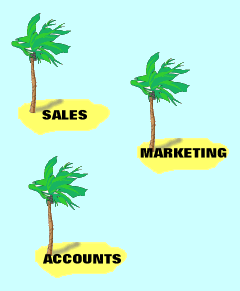
|
Surveys have established that 40% of total IT costs are wasted, because the systems built failed to meet business requirements and were not aligned with strategies of the business. Business Mapping ApproachIn order to build systems that can cope with change, we need to change the way we model the business. We need a model that is:
Such a model is called a business map. It is built by senior managers, is agreed across the business, and thus results in systems that supports the whole business. Because the map contains the fundamentals, it is only built once. So it takes days rather than months. But those days can save you years of effort. 
|